Impasse de la Bergerie
INFOS
- formation 1st year
- année Promotion 2024
- durée 3:57
Impasse de la bergerie
when fantasy becomes a weapon of resistance
With Impasse de la Bergerie, the first-year CinéCréatis Nantes team has produced an ambitious mini-short that blends historical narrative, cruel tale and political fable. Driven by a clear desire to denounce the mechanisms of domination, the film transforms a simple episode of requisition during the Occupation into a powerful allegory of power, violence and resistance.
-
Film pitch
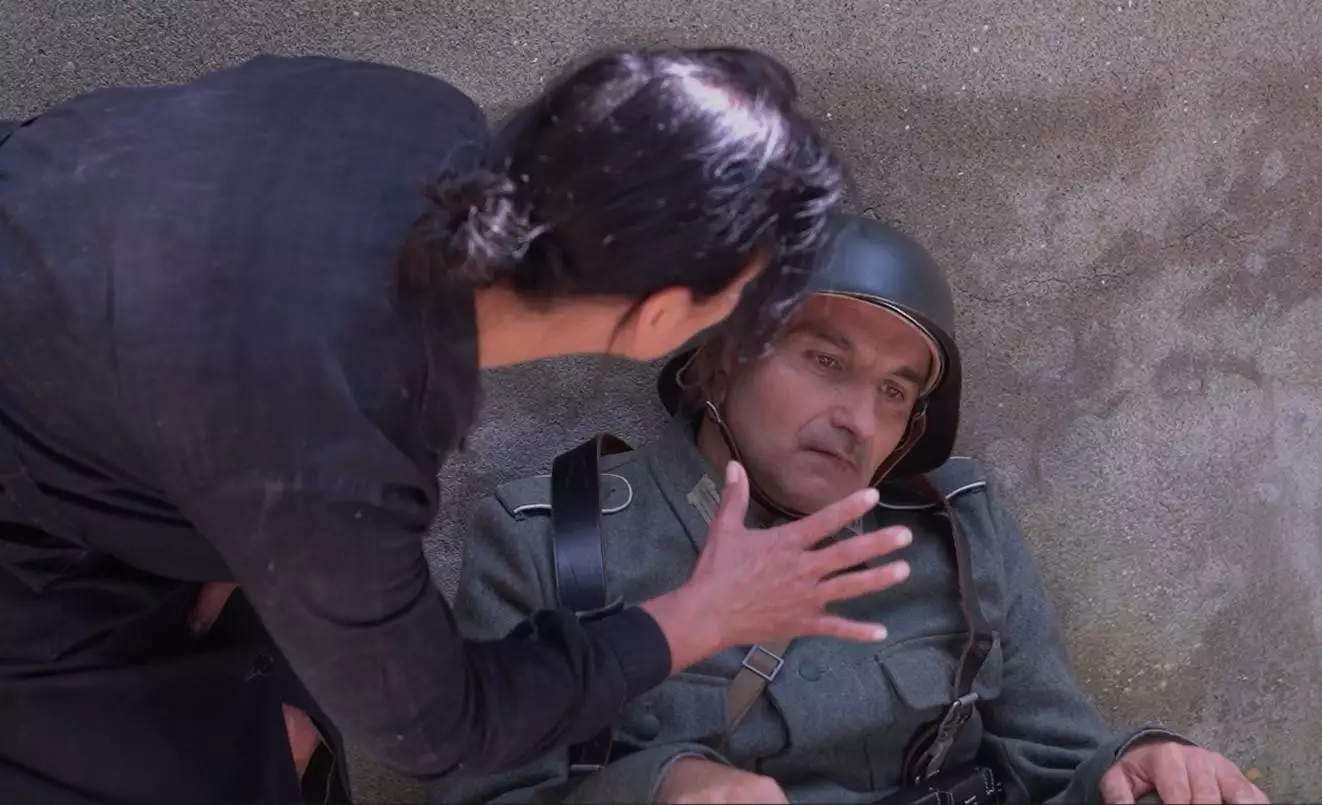
At the height of the Second World War, two Nazi soldiers come to requisition milk from an isolated farm. But behind the apparent hospitality of a lonely shepherdess lies a witch who punishes violent men by turning them into beasts. When one of the soldiers mysteriously disappears, the other leaves convinced that he has deserted… unaware that his comrade is now just another goat.

Nazism laid bare
From the very beginning, the directors have taken on board the moral and political dimension of the project. Inspired by La Fontaine’s fables, the film does not seek to portray the Nazis as grandiose monsters, but rather as grotesque, parasitic figures. Using the metaphor of the goat, Impasse de la Bergerie reverses the balance of power: those who come to “suck the milk of others” end up paying the price.
This idea runs throughout the story. Heinrich, a brutal and arrogant young non-commissioned officer, embodies the blind violence of the regime, while Werner, more passive and opportunistic, represents the silent and cowardly adherence to the system. Opposite them, the shepherdess Colette Lefèvre is no mere victim, but a humble yet formidable figure of resistance.
The witch as a figure of popular resistance
One of the most interesting aspects of the film is the characterisation of the shepherdess. Far from the clichés of the evil witch, Colette is imagined as an ordinary woman, marked by grief and war. Her magical power is not gratuitous: it is a response to the violence she has suffered, a form of implacable justice born of trauma.
The team claims an almost legendary dimension to the character: we imagine this woman as a figure that the villagers would pass down from generation to generation, a protector with terrible but effective methods. Her ability to turn Nazis into goats becomes a metaphor for the dehumanisation of those who dehumanise others.
An aesthetic between realism and dark tale
Visually, the film deliberately plays on a strong contrast between reality and fantasy. The exterior scenes, bathed in natural light, anchor the story in a credible historical reality: that of an occupied French countryside.
Conversely, the interior of the farmhouse gradually shifts towards a more disturbing atmosphere, inspired by the dark tales of the Grimm brothers and contemporary horror cinema (notably Oz Perkins’ Hansel & Gretel). The greenish-orange lighting, the strong shadows and the rustic stone-walled décor all contribute to creating a feeling of confinement and unease.
Sound as a vehicle for the off-screen
The team also attaches particular importance to sound work. The film uses sound as a narrative element in its own right: distant cries, mystical noises, slamming doors, Heinrich’s gasping breathing… All these elements suggest the invisible and amplify the tension.
The choice to have the sound precede and survive the image allows the war to be evoked outside the frame without ever showing it directly. Similarly, the powers of the shepherdess are first manifested through auditory sensations, reinforcing their mysterious and threatening dimension.
A concern for historical reconstruction
Finally, this mini-short film reveals the great care taken with the sets and props. The team set out to recreate a credible farmhouse interior from the 1940s: wooden furniture, metal milk cans, blocked windows, old photos… Nothing is left to chance, in order to maintain a historical coherence that makes the shift towards the fantastic all the more striking.
With Impasse de la Bergerie, the students have created a playful, political and aesthetic work that questions the violence of power while drawing on an ancient narrative tradition: that of the fairy tale, where morality always catches up with the guilty in the end.
Film made during the first year of study at Cinécréatis.
-
Technical team
Director: Alice Huet – Assistant director: Enzo Marangolo – Script: Alexandre Guerin-Baizeau – Cameraman: Nathan Penisson – 1st Assistant Camera: Jules Claymann – Head of Lighting: Anouck Reyes – 1st Assistant Lighting: Arthur Drillaud – Head of Sound: Ange-Emmanuelle Amafou – Boom Operator: Ninon Riou
Mixer: Ange-Emmanuelle Amafou – Editor: Ninon Riou – Composer: Tom the coomposer & Mattéo Burban – Stage Manager: Gabriel Costadau – Assistant Stage Manager: Louve Hougron-Hallier – Head Set Designer: Anouck Reyes – HMC Manager: Léonie Guinoiseau – Communications Manager: Gabriel Costadau
Making-off Manager: Max Lelievre -
Artistic list
Ginette Neveu: The shepherdess – Werner: Frédéric Rezeau – Heinrich: Arthur Potereau-Arnaud