Digital Composer - promotion
Théo Richeux: the image as a field of experimentation
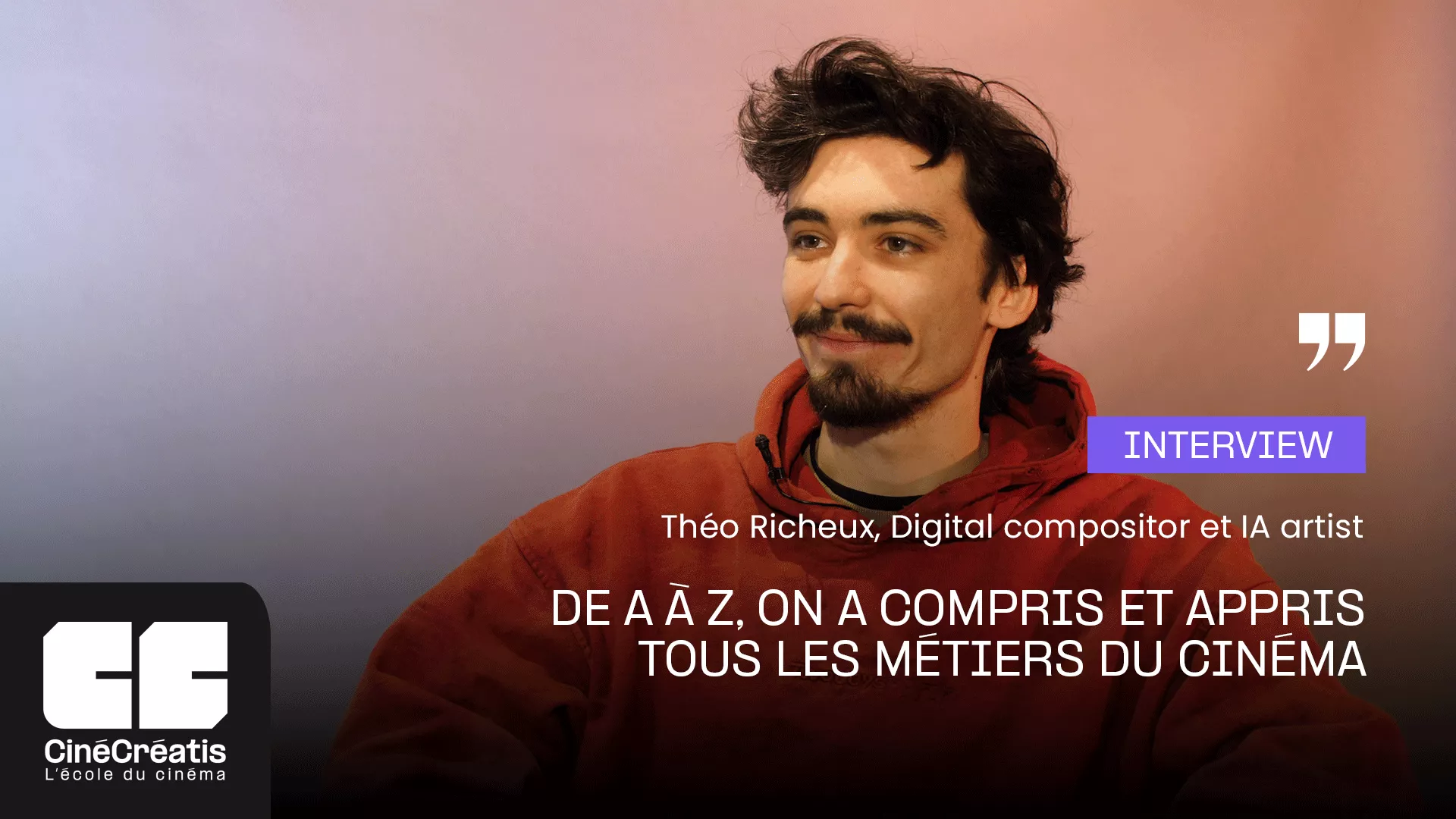
From early home-made film projects to the audiovisual industry
For Théo Richeux, the desire to create images came at an early age. Even before there was any talk of school, specialisation or a career, there were his first attempts, the editing tools he discovered almost instinctively, and his parents’ camera, which he would borrow to shoot little homemade short films. “Ever since I was a kid, I’ve always been playing around with editing tools,” he says. Through constant experimentation, filming and manipulating images, audiovisual production emerged as a natural path. “It just became a sort of given,” he sums up.
His journey began, however, with a baccalaureate in Engineering Sciences, before he gradually turned towards post-production. Drawn to cartoons and 3D animation, he first enrolled at ESMA. But as this initial experience unfolded, another desire took shape: a desire to be on set, to work on location, and to be part of a team in the most hands-on way possible. “I realised I needed a bit more hands-on experience, to be on set,” he explains.
In the corridors, he observed the students at Cinécréatis, always busy with projects, preparing, filming and experimenting. Conversations followed one after another, his interest grew, until it became a conscious decision: to join Cinécréatis to get even closer to the production of live-action cinema.
Cinécréatis, or learning to work as part of a team
What Théo takes away from this course is not just the technical training. It is, first and foremost, an understanding of an ecosystem. At Cinécréatis, he discovers how the various film professions complement one another, but also the need to work together. “From A to Z, we’ve understood and learnt all the film trades,” he says.
This holistic view now strikes him as essential, because it reflects the reality of the industry: a film, a sequence, a shot or a visual effect is never created in isolation. Each stage depends on the others. Every profession must understand the language of the one that comes before and the one that follows.
For him, this collaborative aspect remains one of the most important lessons he learnt during his training. “We learnt to live together, to work together to bring a shared project to fruition. ” In his current role, this ability to engage with other professionals has become indispensable. The vocabulary he learnt, the habits of collaboration, the understanding of everyone’s constraints: all of this still shapes his day-to-day work. “Today, it’s something I can’t do without every single day,” he emphasises.
The professional portfolio: a formative experience
Among the most vivid memories of his time at Cinécréatis, one assignment stands out clearly: the professional portfolio. For nine months, Théo served as director on one of these final-year projects. It was a demanding experience. Resources were limited and constraints were numerous, but the team’s commitment was total. “We really gave it 100 per cent,” he recalls.
He speaks of a project for which they had to fight, work hard, find solutions and maintain the collective energy. Looking back, it is not the difficulties that stand out, but the pride in having stuck together. “We were so close-knit as a team that we fought hard for this film.” Even today, that period remains associated with a kind of joyful intensity: “We still look back on it with stars in our eyes.”
Visual effects as a constant learning curve
It was also during his training that his interest in special effects really took hold. Green-screen workshops, school projects and then his professional portfolio gradually drew him into this world. “As time went on, I discovered a genuine desire and a real passion for special effects,” he explains.
This choice is by no means trivial: visual effects is a field where tools evolve rapidly, methods change constantly, and learning never stops. Far from worrying him, this instability appeals to him. “Working in an environment that’s undergoing such major upheaval and is constantly evolving is something I really enjoy.”
Today, Théo Richeux is a digital compositor and AI artist at Les Tontons Truqueurs. His work involves, in particular, exploring new artificial intelligence tools, understanding what they can actually offer, and considering how to integrate them into existing workflows. The challenge, he believes, is not simply to superimpose technology onto established practices, but to identify relevant applications.
“We’re trying to develop the new artificial intelligence tools that are gradually coming onto the market, and to integrate them into existing workflows,” he explains. The aim is to streamline certain stages, suggest new approaches, and sometimes “go a little further than we were previously able to”.
A cautious yet curious view of artificial intelligence
This stance leads him to view artificial intelligence with caution, but without rejecting it on principle. Théo does not downplay the debates currently taking place within the sector. He refers to “the big ethical questions”, the risk of artistic work being appropriated, and environmental concerns. For him, these questions are legitimate and must remain at the forefront. It is not a question of pretending that the technology is neutral, nor that its development has no consequences.
But he also refuses to reduce AI to its potential abuses. What interests him is what certain artists are beginning to do with it: new narrative forms, unexpected images, aesthetics that might not otherwise have emerged in the same way.
He cites, for example, the work of an artist he recently discovered on Instagram, Leo Canonne, centred on a short film generated or constructed using artificial intelligence tools. What struck him was not just the technical feat, but the film’s atmosphere: a sort of holiday memory filmed on a camcorder, with a 1990s VHS aesthetic, where reality subtly shifts into the fantastical.
“It’s as if it were a holiday trip filmed on a camcorder in the 1990s,” he describes. You’d see a grandmother, a garden, a river, but also magical creatures, such as a mermaid filmed in murky water, with a deliberately imperfect, almost documentary-style look. “There’s a very authentic, very documentary-like quality to it,” he observes.
For Théo, this is precisely where the tool becomes interesting: when it allows him to produce not a spectacular image for its own sake, but a new way of storytelling.
Behind the tools, human connection
This curiosity about technology does not make him forget what he considers to be the heart of the profession. Being a good audiovisual professional, in his view, is not simply a matter of mastering software or keeping up with the latest innovations. Of course, you must ‘always look a little further’, explore, test and dig deeper. But above all, you must enjoy working with others.
‘That’s what our jobs are all about: human contact,’ he insists. In a sector where projects are collaborative by nature, technical skill alone is not enough. You need to be able to communicate, understand other roles, share a common vocabulary and fit into a team. Théo even speaks of a “great need for humanity” in the way these professions are practised.
Going beyond school
That’s also the advice he’d give to a student looking to break into the film industry today: cultivate your curiosity, but don’t expect everything to come from school. A course provides a framework, a foundation, opportunities to meet people and useful challenges. But it is no substitute for personal effort.
“You need to look a little further than what school has to offer,” he says. Embracing new tools, meeting other people, experimenting, showing your enthusiasm: all of this is part of the journey. “Work doesn’t necessarily stop at school.”
For Théo Richeux, training in film is therefore about learning a trade, but also about learning a way of being at work: curious, collaborative, and attentive to others. In an industry undergoing rapid change, particularly with the arrival of artificial intelligence in creative processes, this mindset seems all the more important to him.
Tools change, workflows evolve, narrative forms shift. But one constant remains: the desire to create images with others, and to keep learning. “When you realise you love what you do and want to take it further,” he says, “it’s probably a sign that you’re already on the right track.”