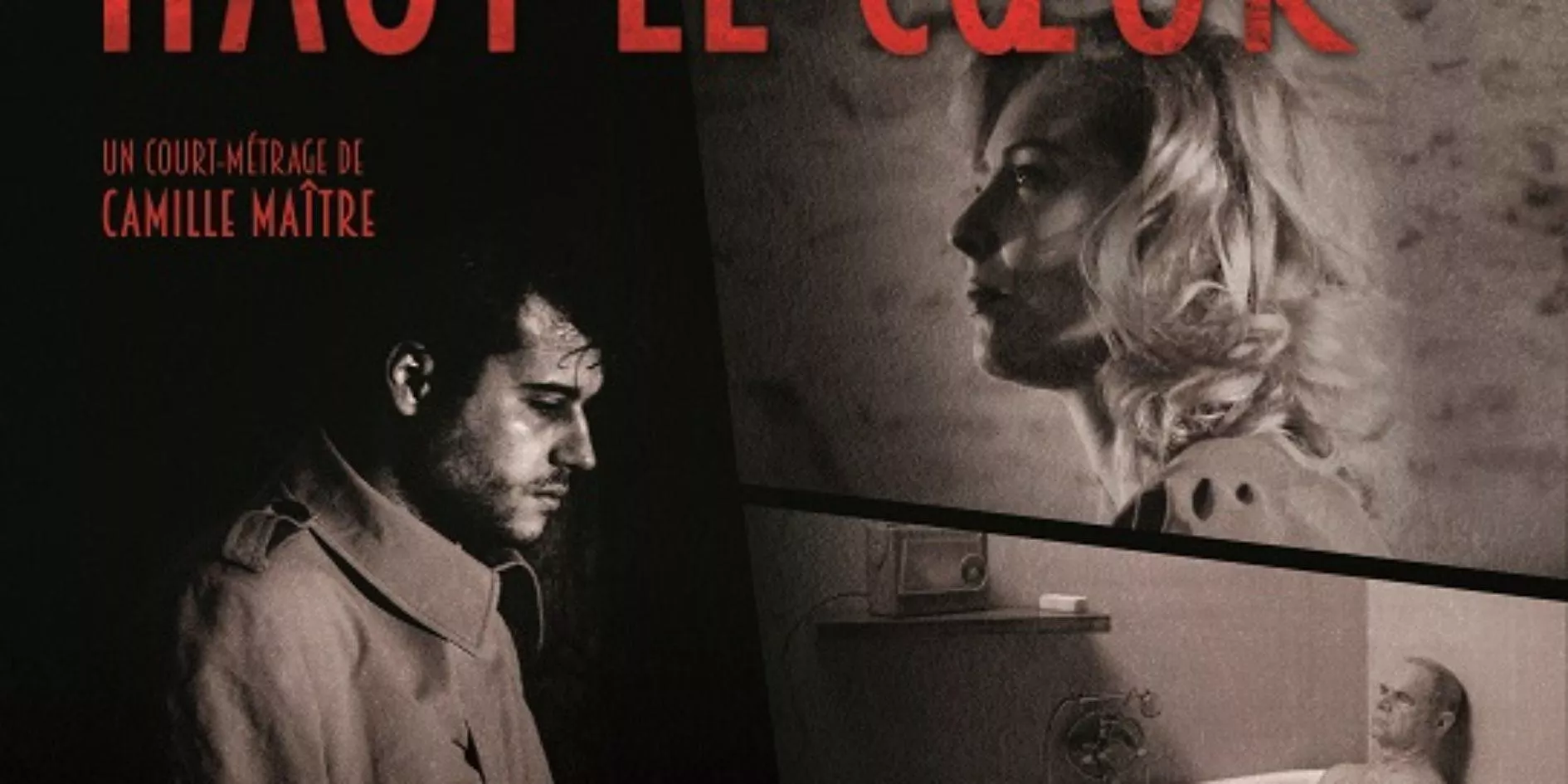
How did this film come about?
During the 2nd year of our studies, we submitted an idea for a film to the school’s teaching staff. The fantastic and magical writing was close to the world of Stephen King, and brought a real originality to the story.
You can feel a very polished style. What are the film’s artistic intentions?
Haut-le-Cœur aims to pay homage to film noir, with its nostalgia for the films noirs of the 40s and 50s, which tend towards the Hollywood classic, and the noir atmosphere that combines the destructive role of the femme fatale and the male hero with his many weaknesses. The strange, unhealthy atmosphere, the duality of the characters and the failure of the main character are all part of this logic.
What is the real central theme of the film?
In this short film, the cruelty and evil intrinsic to human beings take centre stage. Human beings invented evil, and use it to stimulate their emotions, but also to give birth to its opposite, good! In Haut-le-Cœur, the character of Léonard rejects romance and finds refuge in the sordid. Evil becomes his muse and a true source of inspiration. This evolution evokes the dehumanisation of Leonardo’s society, and of society in general, and points the finger at the desensitisation of the public and the role of the media. The film raises the question of responsibility (of the media? of television viewers?), and aims to encourage viewers to question their own relationship with current affairs.
To deal with these issues, you wanted to transpose this reality to France in the 1950s. What did this add to your story?
This leap back in time allows the film to convey a certain nostalgia, by evoking the landmarks of the era (the typewriter, the fashions of the 40s and 50s, jazz…). Moving the story to a time before our own allows us to point to the timelessness and universality of the themes dealt with in Haut-le-Cœur, while maintaining a certain distance. In this way, we avoid falling into anything too edifying or moralising.
The character of Léonard is very complex!
Yes, he is! Like Joe Gills in Billy Wilder’s Twilight Boulevard, Leonard is in serious financial trouble: he can’t make a living from his art, and has racked up a lot of debts. He lives in isolation, which gives rise to a deep-seated anxiety that manifests itself in sensory illusions and a disturbance in his perception of time. In this fantastic world, the line between illusion and reality is more than blurred. His anxiety is also expressed, of course, in the blank page syndrome to which he is prey. The choices this anxiety dictates will bring him face to face with his own conscience. Causality plays a central role in the film: events are interconnected and lead to a predictable end. Haut-le-Cœur is deterministic, and won’t leave viewers hanging!
From a more technical point of view, how did the filming go?
The shoot lasted a week, and the sets were a big challenge. We had to set up and take down 3 sets in the school studio! One of these sets, which represents the main universe of the film, namely Léonard’s flat, required a particularly large amount of work. We also shot in a bar in Nantes, as well as in a superb entrance hall typical of the 1900s.
All in all, it was a tough shoot, with lots of ups and downs! The lack of financial investment didn’t make it easy for us, and we lost a lot of time. But looking back, it was all the more instructive, and the relationship between the different members of the film crew and the cast counterbalanced these difficulties. We were able to stick together and face the challenges together.
How was the film received by the final jury?
To tell you the truth, it got a lukewarm reception. But the jury is still a great moment for each student, and allows us to meet film professionals. In a way, it’s our first step into the world of work.
How do you look back on your years of training at CinéCréatis?
My time at the school has been very formative. From the 1st year onwards, I felt a particular interest in production, and that’s why I’ve had a lot of experience as an assistant director, stage manager and production manager.
From these 3 years, I’ve retained the idea that it’s essential to be surrounded by a team. In the audiovisual industry, you can’t achieve anything on your own! You have to talk, listen, share and support each other.