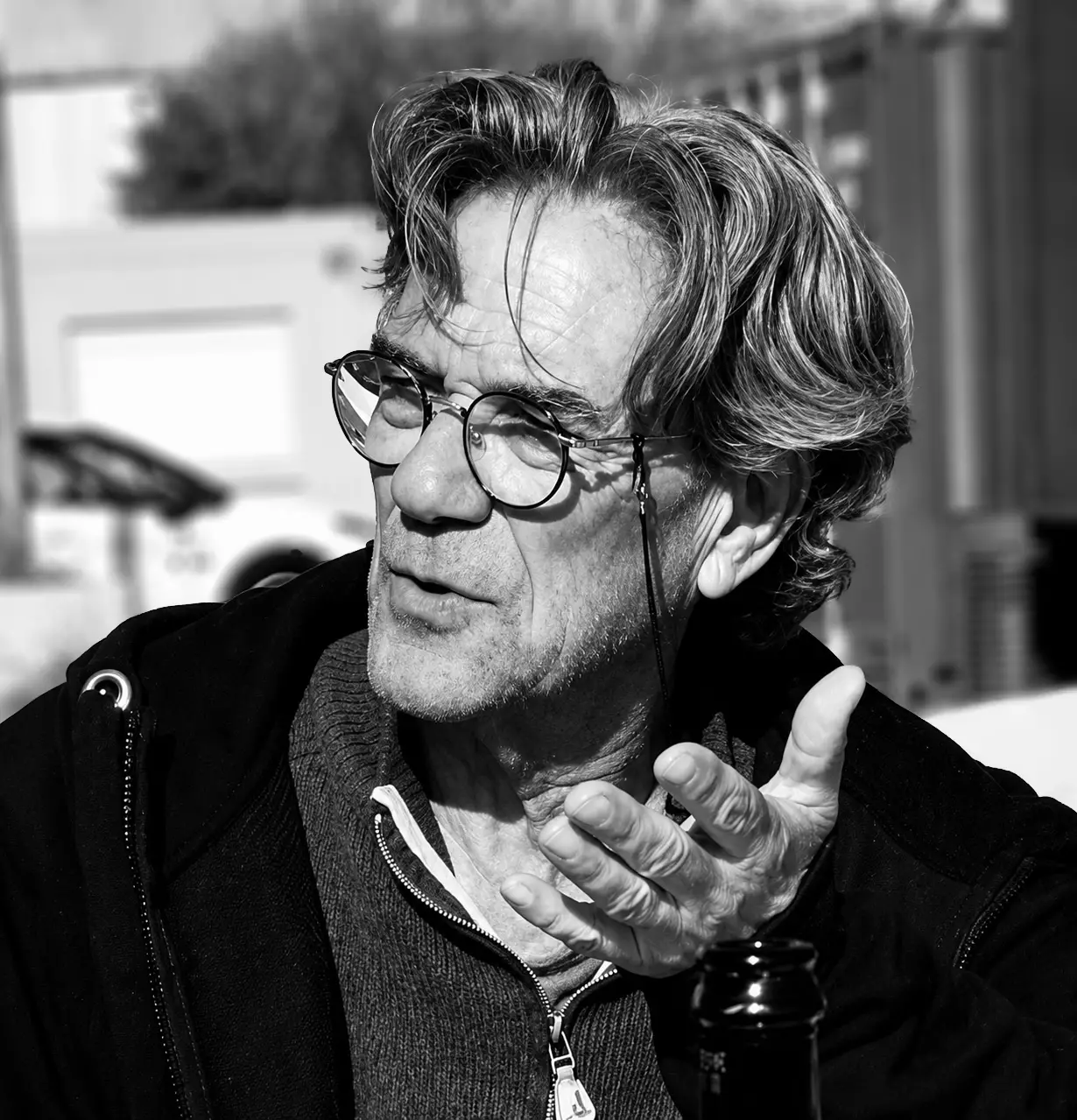
A production designer since the 1980s, Yan Arlaud has spanned several eras of French cinema. Before turning to set design, he worked as a teacher, then as a joiner, a set prop master and a set decorator, before becoming a production designer. A career forged on the ground, working closely with film sets, crews, filmmakers and sets that were sometimes complex to bring to life.
Now based in the south of France, after having lived in the Paris region for many years, he looks back on his career as one of adventure, passing on knowledge and collective creation. He has worked in France, but also extensively abroad, often on demanding film shoots: jungles, the tropics, deserts, period films, large-scale sets and international crews.
“It was a bit like my calling card: the locations we used to call ‘difficult’. I didn’t call it difficult, though. I quite enjoyed it.”
Among his most memorable experiences, he cites in particular *De sable et de sang* by Jeanne Labrune, Rithy Panh’s *Les Barrages contre le Pacifique*, Rachid Bouchareb’s *Hors-la-loi*, and Bernard Giraudeau’s *Les Caprices d’un fleuve*, a film to which he remains particularly attached.
Now retired, Yan Arlaud continues to pass on his knowledge. He delivers training sessions, particularly at schools and professional organisations, with the aim of helping young people enter a profession about which he speaks with clarity, sometimes with concern, but also with undiminished passion.
From French film sets to sets built abroad
Yan Arlaud belongs to a generation that learnt the film trade through hands-on experience. He speaks of this without excessive nostalgia, but with an awareness of a career forged through direct contact with the profession.
“At first, I was a teacher. Then I left the state education system. I started out as a carpenter. Very quickly, I became a set prop master, a set builder, and then a production designer at a fairly young age.”
He regards this step-by-step progression as fundamental. Set design is not merely a matter of aesthetics or technique. It is a craft involving creation, dialogue, interpretation and an understanding of the drama. A craft in which one moves from a text to an image, from a director’s vision to a tangible space.
Filming abroad soon became a significant part of his career. He set off with small French crews, then found himself working on large-scale productions. Speaking of Rachid Bouchareb’s *Hors-la-loi*, filmed largely in Tunisia, he recalls the construction of a major set with a small French management team and a very large local crew.
“We had up to 200 people in Tunisia. A small French management team, and a huge Tunisian crew.”
This penchant for filming under unusual conditions has remained a constant. Sets built outside the usual parameters, practical constraints, constant adaptations: all these elements, for him, are also part of what makes the profession so rewarding.
*Les Caprices d’un fleuve*, a landmark film
When asked to name a particularly memorable project, Yan Arlaud immediately thinks of *Les Caprices d’un fleuve*, directed by Bernard Giraudeau. The film holds a special place in his career, both for its aesthetic rigour and for the quality of the collaborative work carried out in the run-up to production.
“It’s one of my favourite films. A period piece that I find absolutely beautiful, where aesthetics really play a major role. The set design is truly recognised.”
What strikes him is the way the visuals were conceived. Working with Bernard Giraudeau, director of photography Jean-Marie Dreujou and the costume designer, the task was not merely to fulfil a set of specifications. It was about crafting a vision.
“We really did compose the images. Unfortunately, this is something that’s becoming increasingly rare in cinema. We were shooting on 35 mm, doing test shots. I think the film is magnificent. It’s truly a film I’m proud to be associated with.”
Yan Arlaud speaks of this film with particular emotion. He still watches it regularly, with pleasure. In his view, *Les Caprices d’un fleuve* embodies a certain idea of cinema: a collective art, carefully conceived and crafted, where set design plays a full part in the drama and visual power of the narrative.
An industry weakened by economic and political choices
When it comes to the current state of cinema, Yan Arlaud does not mince his words. He considers the situation difficult, although he is careful to point out that cinema has already weathered numerous predictions of its demise.
When he was starting out, his father, a screenwriter, told him that the advent of television signalled the end of cinema. Later, digital technology was supposed to have made set design obsolete. That did not happen. On the contrary, these developments have sometimes opened up new creative possibilities.
But this time, in his view, the situation is different. Not only because of technology, but because several vulnerabilities are converging: declining funding, economic concentration, shifting editorial policies, attacks on public service broadcasting, and an ever-shrinking space for creative work.
“I believe the sector is in an extremely difficult situation. I want to put this into perspective, because the end of cinema has been predicted many times before. But now, we’re entering a phase where jobs are actually starting to be cut.”
What worries him is not just artificial intelligence. It is the context in which it is emerging. In his view, this technological tool is part of a broader trend towards cost-cutting, standardisation and the weakening of cultural policy.
In particular, he refers to the shrinking budgets for what used to be known as ‘mid-budget cinema’: ambitious arthouse films, funded at levels that allowed for genuine artistic and technical rigour.
“I’ve seen better days. Mid-range cinema used to be funded to the tune of 6 or 8 million euros. Today, if we get 2 million, we’re happy.”
This reduction in funding does not just affect sets. It undermines the very possibility of making films with sufficient time, crews, costumes, experienced actors, set construction and rehearsals. In short, everything that allows cinema to be more than just a product.
Artificial intelligence: a tool, not a creative force
Yan Arlaud does not reject artificial intelligence as a tool. But he opposes the idea that it can replace creative thinking. For him, the danger arises when AI is no longer used as a support, but as a means of bypassing the various film professions.
He gives the example of a production designer approached for a major production. The director showed him an AI-generated image and simply asked him to recreate that set.
“The production designer told him: ‘If you’re calling a production designer, it’s precisely so that we can discuss things. Our job is to take a written script, transform it, propose a visual concept and create a backdrop. AI is a tool, but it isn’t creation.’”
The problem with this example isn’t that the image was generated by a machine. The problem is that the creative dialogue disappears. The production designer is no longer called upon to interpret, propose or construct a visual world. They become a mere executor.
“We’re doing away with a creative role. An image is generated by AI – often a very limited one – and then someone is asked to execute it.”
He finds this approach all the more worrying given that, in his view, the oversight of set design is already tending to become more superficial. Production designers may be called upon to come up with an idea, a budget and drawings, only to be sidelined during the implementation phase. He sees this as a loss of coherence, comparable to a head chef who provides a recipe but is unable to lead his kitchen team.
The professions most at risk
Yan Arlaud identifies several professions that are already under pressure or directly threatened by technological and economic changes. He cites dubbing and post-production first and foremost, but also editing, which he regards as a genuine second act of direction.
“Editing is, after all, a second form of direction. Entrusting this to a tool is anything but neutral.”
Screenwriters, actors and certain types of visual effects artists are also, in his view, at risk in the short to medium term. In the field of set design, he is thinking in particular of graphic designers responsible for creating fictional brands, advertising campaigns, graphic materials and visual elements for period films or specific worlds.
“These are professions that risk disappearing, or being reduced to someone simply operating an AI, with less expertise and a much lower salary.”
Here again, the issue is not merely technical. It is economic. What Yan Arlaud highlights is a drive to produce more, faster, with fewer resources, sometimes at the expense of creative quality and working conditions.
Training faced with a paradox
Yan Arlaud continues to work in training, but he observes the sector with caution. He knows that schools play an important role in giving young people a solid foundation, enabling them to enter the workforce more quickly and to understand the realities on the ground.
But he also raises a broader question: are we training for knowledge, for business, or for both? And above all, are we training too many people relative to the actual job opportunities available?
“We’re training a lot of people at the moment. That’s the whole debate: are we training for the sake of knowledge, for the sake of business, or for both?”
For him, entering the profession remains a gradual process. Young people can be trained, supported and prepared, but they inevitably start at the bottom of the ladder. It is on the job that their aptitudes are confirmed. And very quickly, he says, a difference becomes apparent: passion.
“After just two days of lessons, you can already tell who’s got what it takes. Not because they already know everything, but because you can sense that it’s vital to them.”
This passion does not replace skills. It is the driving force behind them. It spurs you on to learn, to observe, to stay longer, to ask questions, to try again, to accept the challenge. Without it, the profession becomes almost impossible to sustain.
Passion as the decisive factor
When asked what makes a good film professional, Yan Arlaud replies without hesitation: passion.
Not a vague or superficial passion. A concrete, everyday, almost physical passion. The kind that makes you want to arrive on set an hour early, have a coffee with the crew, stick close to the director, and immerse yourself in the film’s dream world.
“Passion can’t be explained. It’s something intangible, a feeling that resides deep within you and drives you to reach for the moon if you have to.”
He also emphasises the need to look after yourself. Passion can be exploited. It can lead you to accept impossible weeks, excessive working hours and overly demanding working conditions. Cinema remains a demanding, sometimes brutal profession, where personal commitment is very strong.
But despite this, Yan Arlaud does not believe in cinema without passionate people.
“You can have a very good technician, very skilled in architecture or design. If they don’t have the passion, there’s no point. It’s a profession for madmen, and therefore a profession for enthusiasts.”
A lack of cultural awareness: a warning sign
When it comes to the younger generations, Yan Arlaud is careful not to say that “things were better in the old days”. But he does nevertheless observe certain weaknesses that worry him.
The first concerns general knowledge and film culture. He mentions students who are very familiar with certain contemporary worlds, particularly those of video games, but who are unaware of major references in cinema or literature.
“When you mention Méliès, Godard, Pialat, or even more recent filmmakers, you’re met with blank stares. They know the creator of the latest video game, which is all well and good. But they sometimes have absolutely no knowledge of cinema.”
This lack of cultural awareness poses a direct problem in the creative professions. In set design, for example, you need to be able to understand an era, a context, a reference, an intention. It’s not about being a walking encyclopaedia, but about having a foundation that enables dialogue.
“When a director talks to you about the discovery of America and you place it in the 19th century, you’re done for.”
He is also concerned about the overly automatic reliance on artificial intelligence for writing, researching and formulating ideas. Not because we should reject these tools, but because using them too early can weaken the ability to reason, to write and to connect ideas.
“The shortcut of simply posing a question to AI to get an answer is extremely dangerous. The earlier young people get used to this, the more their reasoning skills are likely to suffer.”
Reading, listening, thinking: the foundations of the profession
For Yan Arlaud, the set designer’s craft begins before the drawing stage. It begins with reading. Reading a story. Understanding what it is about. Identifying what needs to be in the frame to support the narrative. Then discussing it with the director, listening, rephrasing, making suggestions.
“Our profession is, above all, one of reflection. We read a story and must create an image – sets – that match the image the director has in their mind.”
He points out that he didn’t come to set design through drawing, but through conversation, discussion and the ability to engage with directors. For him, the set design emerges from this interplay between text, thought, culture, materials and imagery.
This is also what he seeks to convey to young people: not to rely solely on tools. To know how to work with a sketchbook, a pencil, a discussion, and research materials. To know how to think even without a computer, even without an internet connection, even without immediate assistance.
“I’ve worked a lot in the desert. Sometimes we couldn’t plug in the computers because the generators weren’t regulated. So we’d go back to our notebooks.”
Cinema in the face of the rapid consumption of images
When it comes to streaming platforms, TV series, YouTube, video games or new ways of consuming content, Yan Arlaud rejects simplistic judgements. He acknowledges that there are now some very good TV series, remarkable video games and high-quality content across various media. He does not look down on these formats.
But he is concerned about an increasingly rapid, fragmented and immediate mode of consumption. The ‘all-phone’ lifestyle, short videos and the constant stream of images can, in his view, alter our relationship with attention and concentration.
“What’s really troubling is the speed. The short videos, the short formats. We see children, but also young professionals, who struggle to stay focused on a single detail for any length of time. ”
Yet careers in cinema demand precisely this ability to stay focused on an idea, a sketch, a structure or a modification, sometimes for days on end. Conceiving a set is not the same as consuming an image. It involves letting it mature, testing it against other ideas, modifying it and making it possible.
He believes that cinema may need to rediscover a kind of ‘sacred’ quality, like theatre. Not in the sense of an art form reserved for the few, but as an experience that requires a specific space, attention and a willingness to engage.
‘A film is not a game, it is not a photograph, it is not a book. We must preserve this uniqueness.’
Fostering an appreciation for culture
Yan Arlaud remains convinced that a relationship with culture is something that is built up. He talks about his grandchildren, visits to museums, books in the home, and the role of adults in fostering a desire.
“It’s up to us too to take them along, to instil that desire in them. With my granddaughter, when we go to the museum, it’s a treat. We’re creating a desire in her. I hope that as she grows up, she’ll hold on to that desire.”
Yet he knows that not everyone has the same access to these activities. Cultural inequalities already exist and, in his view, are likely to become more pronounced. That is why he often returns to the political question: what place do we actually give to culture? In schools? In local communities? In funding? In public broadcasting?
For him, the main danger lies not only in changing habits. It lies in the weakening of a collective cultural ambition.
“What worries me most is the disappearance of a genuine cultural policy.”
A career that also relies on networking
To a student keen to break into the film industry, Yan Arlaud would offer one simple piece of advice: meet professionals, forge connections, and build a network. Not as a matter of privilege, but because these professions are still largely passed on through personal encounters, recommendations, set experiences and shared experiences.
“The network has long been very closed. We’re trying to open it up. We’re here to help young people build a network, sometimes even more so than to pass on knowledge to them.”
He cites the work being carried out in Occitanie by various organisations and associations that bring young people together with professionals. For him, this openness is essential. It helps to build bridges, prevent isolation and provide a practical understanding of the industry’s unwritten rules.
But he isn’t selling an easy dream. Places are scarce. The profession is demanding. Intermittent work, starting out, first assignments, periods of waiting: all this is part of the reality.
“It’s the best life in the world”
Despite his concerns about the sector’s future, Yan Arlaud refuses to be fatalistic. He sees the threats, the vulnerabilities, the economic and political attacks. He also sees the impact of AI, the changing nature of jobs, and the roles that are at risk of disappearing.
But he still believes in the power of cinema, in the need for creators, in the strength of teams and in passing on knowledge.
“I’m worried, but I remain optimistic. There is a force, and that force is us, the people involved in culture. ”
His final piece of advice to young people can be summed up in a few words: don’t ignore the difficulties, but don’t give up if the passion is there.
“It’s the best life in the world. Places are hard to come by, but it’s definitely worth it.”