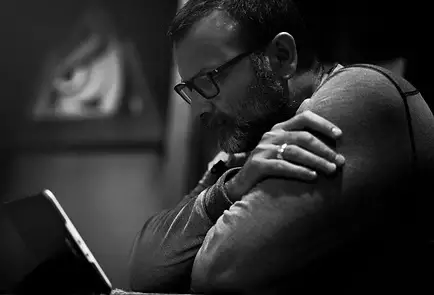
At a time when the film and audiovisual industries are undergoing profound changes, giving a voice to the people who make these professions happen on a daily basis helps us to better understand the realities on the ground. An experienced film-maker, Bruno Richaud takes a lucid, passionate and nuanced look at the current state of the industry, how it is changing and the challenges facing future professionals.
A multi-faceted career at the heart of creation
It’s hard to sum up such a rich career in just a few words. As a director, but also having worked in production and for major television companies, Bruno Richaud embodies this generation of professionals capable of navigating between different formats and worlds.
He is currently working on the series Un si grand soleil, broadcast on France Télévisions. This is a fast-paced production schedule, typical of daily series, which demands constant efficiency while maintaining high standards.
At the same time, he is developing several projects:
- Short films being shown at festivals,
- A new film in preparation in the Occitanie region,
- A feature-length film under discussion with a view to international co-production,
- And hybrid formats designed for digital platforms.
This multitude of projects is not insignificant. It reflects the reality of today’s profession: the need to be on several fronts at once, to multiply assignments and to constantly anticipate.
” You have to be on all fronts “, he explains. It’s a phrase that sums up the changing face of careers in broadcasting.
Television, drama and entertainment: experiences that shape you
Bruno Richaud has explored many areas of the audiovisual industry. In particular, he was one of the first teams on Koh-Lanta, a remarkable experience filmed on the other side of the world, with considerable production resources. He is also involved in Fort Boyard, where he has worked for nearly 17 years on the creation of the visual and narrative universe. This longevity testifies not only to his expertise, but also to his ability to work in both popular and demanding formats.
These experiences, sometimes far removed from traditional fiction, are a real learning experience. They allow us to develop a high level of technical mastery, as well as a particularly formative ability to manage stress and the constraints of filming.
” When you’ve worked with twenty-five cameras in extreme conditions, fiction becomes almost comfortable “, he confides.
Today, this diversity of career paths is a major asset in a sector where versatility has become the norm.
A crisis… or a transformation?
For several months now, the term ‘crisis’ has been a recurring theme in the film and audiovisual industry. A drop in productions, economic uncertainties, difficulties for technicians and actors: the observation is shared by many players in the sector.
But for Bruno Richaud, this reading needs to be qualified: “It’s not a crisis of desire. People still want to see films and series. It’s a transformation of the business model.
In his view, the industry is undergoing an in-depth reorganisation. Funders are becoming more cautious, producers are looking to secure their investments, and projects now have to meet higher profitability requirements.
This situation is giving rise to two parallel movements:
- On the one hand, a concentration of resources on recognised formats or solid franchises.
- On the other, the need to continue innovating to renew content.
It’s a delicate balance, but one that is vital if the sector is to survive.
The irruption of platforms and digital
It is impossible to talk about the audiovisual industry today without mentioning the growing role of platforms. Players such as Netflix, YouTube and Twitch are redefining the rules of the game.
The recent agreement between France Télévisions and YouTube is a perfect illustration of this development: traditional broadcasters must now invest in the digital arena, not only to broadcast, but also to produce. For Bruno Richaud, this change is not a threat, but an opportunity. It opens the way to new formats, new ways of writing, and new ways of telling stories adapted to different uses.
He is himself working on a hybrid project, at the crossroads of televised games and Twitch codes, proof that the boundaries between formats are becoming increasingly porous.
Changing consumption patterns
One of the major upheavals currently taking place concerns the way in which content is consumed. Where cinema offered a collective experience and television a family experience, digital is introducing individual consumption. This change is not neutral. It has a direct influence on formats, durations and narrative rhythms. The “short drama” phenomenon, which originated in Asia, is a striking example: very short episodes, often in vertical format, designed for viewing on smartphones.
Should we see this as a threat to cinema and television? Bruno Richaud doesn’t think so.
“Each medium corresponds to a different use. You don’t watch the same thing alone on your phone as in a cinema with 300 people.
In other words, rather than head-on competition, it’s about diversifying experiences.
The challenge of funding
While the forms are evolving, the question of funding remains central. In fact, according to the director, it will be one of the main challenges in the years to come.
With the relative decline in some public funding and the rise of private investment, producers now have to take more risks. They also have to think about their projects in terms of profitability and return on investment.
This implies a profound transformation in the way works are conceived. It’s no longer just a question of creating, but also of thinking about the audience.
“You can’t ignore the spectator. They are the ones who make the system work.
This reality means that we have to strike a balance between artistic ambition and economic viability. A delicate exercise, but one that cannot be ignored.
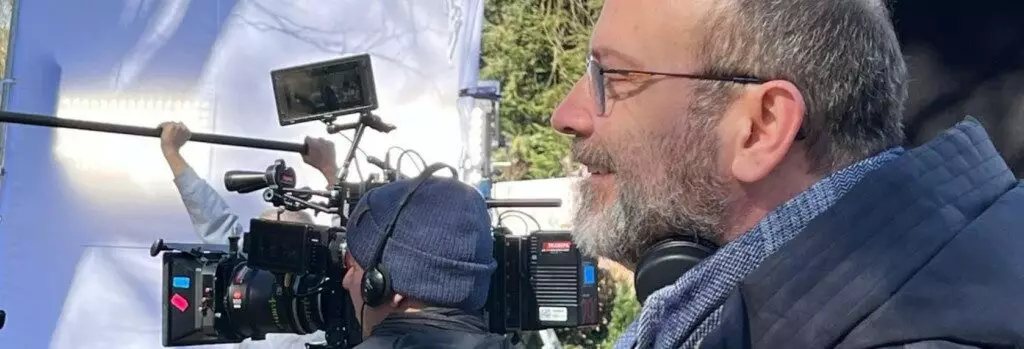
Artificial intelligence: fascination and questions
Artificial intelligence is another key topic in our discussion with Bruno Richaud. Between technological fascination and legitimate concerns, it is gradually making its way into the creative process. Bruno Richaud takes a pragmatic approach. For him, AI is first and foremost a tool, the impact of which will depend on how designers use it.
He mentions Georges Méliès, an emblematic figure of innovation in cinema, to illustrate this idea: new technologies have always aroused fears, but they have also enabled new artistic forms to emerge. Just as the invention of photography transformed painting, AI could redefine certain practices without replacing human creativity.
The central question then becomes: how can we differentiate ourselves in a world where tools make it easier to produce?
France on the international stage
In an increasingly globalised market, French production is also having to rethink its place. Long focused on its domestic market, it is now being forced to open up further. Platforms such as Netflix are encouraging this internationalisation, by offering content that is destined to circulate beyond national borders. In Bruno Richaud’s view, France has genuine expertise, but it needs to be prepared to produce works designed for a wider audience, sometimes using different codes.
This does not mean giving up its identity, but rather learning to make it interact with other cultures and other expectations.
The qualities of a professional today
Technological and economic developments aside, one constant remains: human qualities are still essential. For Bruno Richaud, being a good audiovisual professional is not just about technical skills. It’s a balance between know-how and interpersonal skills.
In his opinion, the essential qualities include :
- A passion for the job and for the work,
- The ability to persevere in a competitive environment,
- A taste for teamwork,
- genuine interpersonal intelligence.
“Cinema is a collective endeavour. We all depend on each other.
He also stresses the importance of adaptation. Every shoot, every team, every project is different. Knowing how to constantly adjust is a key skill.
Training, adapting, evolving
In a constantly changing industry, ongoing training is essential. Tools evolve rapidly, and professionals need to challenge themselves regularly. Bruno Richaud talks in particular about the technological transformations he himself has gone through, from a time when laptops didn’t exist to the current era of digital technology and AI. His advice is clear: don’t wait to adopt the new tools.
“The earlier you start, the easier it is. Otherwise, you run the risk of being left behind.
A message to future professionals
The director’s message to those wishing to enter the audiovisual industry is both realistic and encouraging.
Yes, the industry is demanding. Yes, the competition is tough. But passion remains the main driving force. He also reminds us that the viewer’s eye is fundamental. Before you can create, you have to enjoy watching, understanding and analysing, but you also have to be able to let yourself be carried away by a work. Finally, he insists on an essential idea: to last in this profession requires a balance between skill, adaptability and human relations.
A sector on the move, creativity intact
One thing is clear from this account: the audiovisual industry is not in decline, it’s changing. With new technologies, changing usage patterns, a reshuffling of funding and an international outlook, the challenges are many. But they are also accompanied by unprecedented opportunities.
For professionals and students alike, the challenge now is to understand these changes, adapt to them and find their place within them. Because beyond the tools, formats and business models, one thing remains constant: the need to tell stories. And as long as this need exists, cinema and the audiovisual industry will continue to evolve, to surprise and to bring people together.