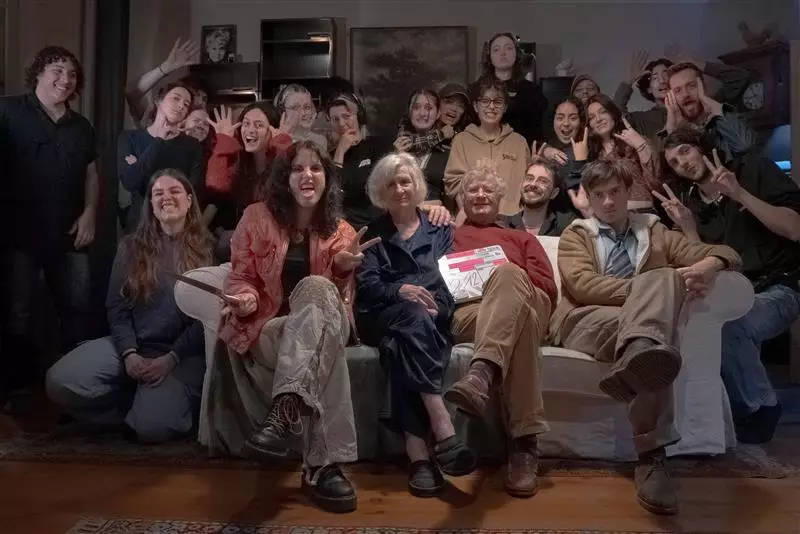
In their final year at CinéCréatis, students make a film for their graduation. This project, carried out in conditions similar to those of a professional film shoot, requires considerable technical resources and a large team of technicians. It enables students to put into practice all the skills they have acquired during their training.
On the Bordeaux campus, the team is currently working on the short film “Introspection d’une serial killeuse”, by director Noa Gros, based on an original screenplay by Loris Briand.
a hybrid short film between horror and comedy
Introspection d’une Serial Killeuse is an ambitious short film that relies on a high degree of coherence between all the production departments: writing, direction, image, sound, set design, acting and post-production. Above all, the whole team is seeking to create a hybrid film, a cross between comedy and horror, capable of dealing with a profoundly contemporary subject: loneliness and the lack of connection.
From the outset, the scriptwriters wanted to show two opposing but complementary forms of loneliness. The character of Samy embodies a form of self-effacement, a withdrawn existence, while Martha, a burned-out serial killer, represents excess and the flight into violence. The film does not seek to justify this violence, but to show it as a symptom of an emotional void. This positioning gives the project a particular tone: behind its absurd and comic aspect, it is above all a human, almost intimate story, where the meeting between two characters cracks their isolation without ever resolving it completely.
The direction is a direct extension of these intentions, working on the place of the bodies and characters in the frame. The relationship of domination between Martha and Samy is expressed visually: Martha occupies the space, often in motion, filmed with a hand-held camera using short focal lengths that slightly distort her face and accentuate her instability. In contrast, Samy is filmed with long lenses, crushed into the image, as if enclosed in his own world. This contrast evolves over the course of the story, accompanying the transformation of the characters. The mise en scène thus becomes a narrative tool in its own right.

A film where the spaces speak as much as the characters
Image also plays a key role, particularly through light and colour. The film is based on a strong chromatic opposition: cold, dull tones for Samy (blue, grey), against warm colours for Martha (red, orange). This opposition is more than an aesthetic characterisation, it reflects their inner state. Gradually, these palettes blend, reflecting the influence they exert on each other. The cinematographer’s job is to make this evolution visible while maintaining a strong visual coherence.
The sets and props also contribute to the narrative. Samy’s flat is designed as a frozen space, almost out of time, filled with impersonal objects that reflect his isolation. In contrast, John’s apartment, the venue for the party, is modern, spacious and warm, symbolising a form of social success that Samy finds unattainable. As for Martha, she is defined by her accessories: her murder tools, worn and full of history, become almost extensions of her character. Every visual element is designed to reinforce the film’s characterisation and contrasts.

Between humour and unease: a short film driven by acting and sound
Acting is another essential pillar. The project is based on very strong characters, whose balance between humour and discomfort depends largely on their interpretation. The casting was designed with this in mind: an actor capable of conveying Samy’s clumsiness and gentleness, particularly through dance, and an actress for Martha, who is at once intense, disturbing and capable of a form of innocence. The film’s humour rests largely on this direction of the actors, on their ability to navigate between first and second degree.
The sound and music enhance this approach. The film plays with contrasts in sound, between moments of silence and disturbing sound design (linked to Martha’s actions) and lighter, more festive musical passages. The music, ranging from melancholy jazz to more rhythmic pieces, accompanies the story as it develops, and in particular sets the scene for the dance, a key moment in the film.

Post-production for a hybrid film between humour and solitude
Finally, post-production brings all these elements together. The editing follows the emotional variations of the story, alternating between slow introspection and chaotic energy. Mixing and colour-grading reinforce the contrasts in tone and colour, bringing this mix of genres to life.
In this way, all the poles converge towards the same ambition: to create a film that is sensory, contrasting and profoundly human. Introspection of a Serial Killer is not just a horrific comedy, but a reflection on relationships and solitude, supported by a coherent technical and artistic production, despite limited resources.
This graduation film stands out for the scale of its production, with more than 30 technicians mobilised around the project, alongside 4 main actors and around twenty extras. The filming, spread over 8 days, was organised in a way that closely resembled professional conditions, with an overall budget of €11,000, enabling ambitious technical and artistic resources to be deployed.
Introspection d’une Serial Killeuse will be screened at the Cinécréatis Grand Jury at the Bordeaux cinema in early July. Students and their families will have the opportunity to see the film on the big screen.