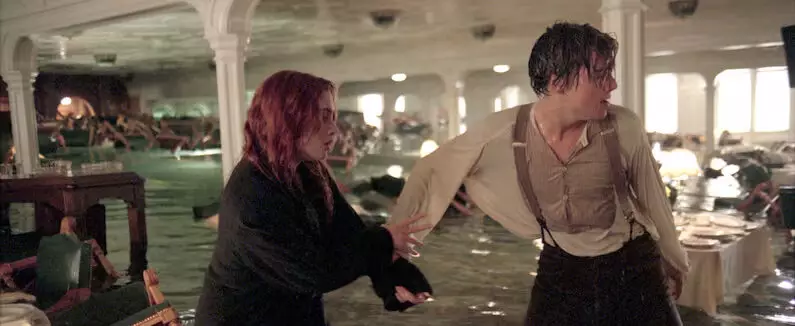
1. Titanic: The organisation of space and the clarity of the action
James Cameron’s film is a textbook example for the study of large-scale film direction. Behind the apparent plot, the direction is subject to a strict constraint: making the vastness of the setting comprehensible and maintaining spatial clarity during complex action scenes.
Managing scale
Cameron uses depth of field and crane shots to establish the geography of the liner. Before the disaster strikes, the viewer has already grasped the ship’s various levels, the position of the engines in relation to the upper decks, and the distances separating the social classes. This preparatory work on the framing enables the viewer, in the second half of the film, to immediately grasp the physical stakes of each sequence.
Structural editing
The sinking scene relies on editing that alternates between the immediate actions of the main characters and wide shots showing the ship’s list. The pace of the editing accelerates in proportion to the rising water. On-axis cuts are used to emphasise the sense of urgency without disorienting the viewer. The film demonstrates that spectacular action only works if it remains geographically comprehensible.
2. Psycho: The Architecture of Tension and the Manipulation of Perspective
Alfred Hitchcock constructs*Psycho*as an exercise in narrative and visual manipulation. A study of this film helps us understand how the director controls the information conveyed to the audience.
The narrative break
The screenplay eliminates its main character at the end of the first third. This break is made possible by an abrupt shift in point of view. The camera, which had been following Marion Crane in an almost clinical manner, suddenly adopts Norman Bates’s perspective. Hitchcock uses point-of-view shots and foreshadowing to force the viewer to align with the murderer’s logic, creating tension based on unwitting complicity.
Technical editing
The shower sequence remains an absolute technical benchmark. It consists of 78 shots and 52 cuts, condensed into 45 seconds. The aim is not to show the violence, but to suggest it through the rhythm of the editing. The rapid cuts, combined with the strident tones of Bernard Herrmann’s score, create a sensory assault. Here, Hitchcock demonstrates that the impact of a scene depends on the fragmentation of time and space during filming, designed specifically with the editing room in mind.
3. The Godfather: The use of light and the deliberate slow pace
The work of Francis Ford Coppola and his director of photography, Gordon Willis, onThe Godfatherredefined the approach to lighting and pacing in cinema.
The art of underexposure
Willis chose to underexpose the interior scenes. The light often comes from above, casting deep shadows across faces and sometimes obscuring Marlon Brando’s eyes. This aesthetic choice serves a dramatic purpose: it conveys the characters’ secrecy, confinement and moral ambiguity. The deliberately warm and dark colour grading contrasts with the overexposure of the outdoor scenes, particularly during the sequences in Sicily, marking a clear contrast between spaces of power and public spaces.
Parallel editing
The final baptism sequence illustrates the effectiveness of parallel editing. Coppola alternates shots of the religious ceremony – punctuated by the organ and the priest’s words – with the brutal murders ordered by Michael Corleone. The contrast between the sacred and violence is achieved through the synchronisation of the actions. The slow, steady pace of the editing at the beginning accelerates, transforming a juxtaposition of events into an inescapable conclusion about the nature of power.
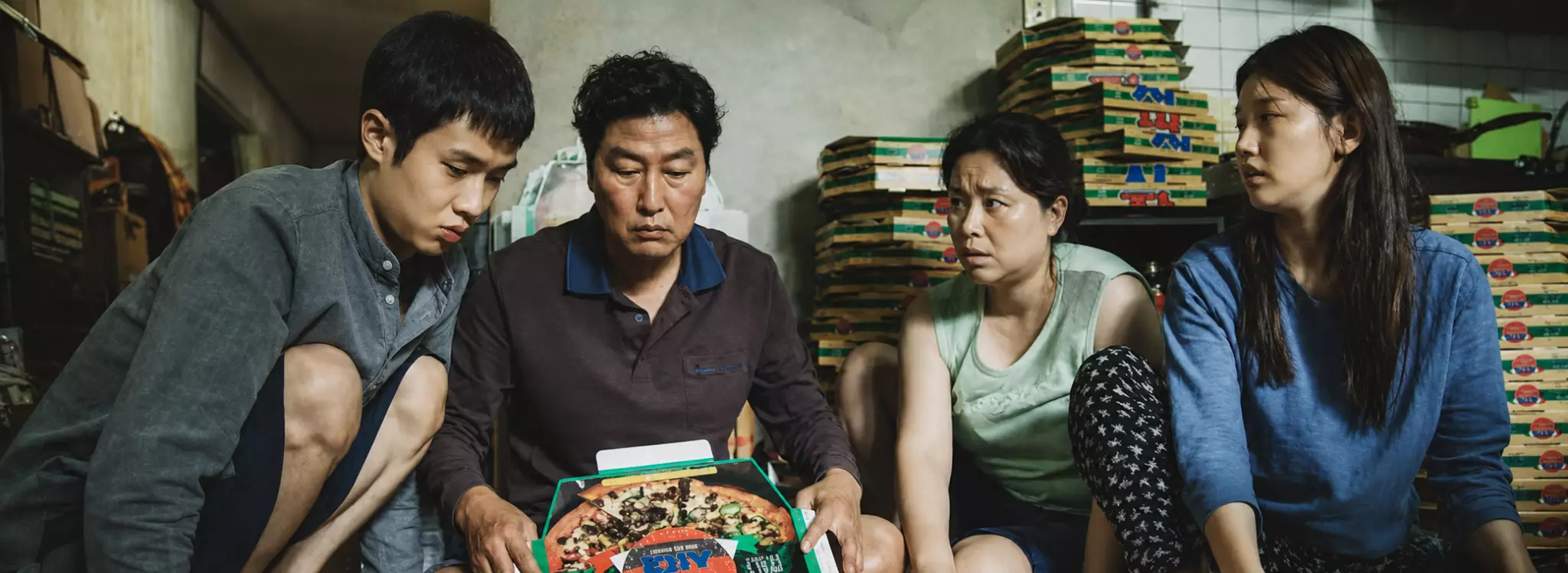
4. Parasite: Segregation through the geometry of the frame
Bong Joon-ho uses architecture and the composition of the frame to convey class relations. InParasite, the setting is not merely a backdrop; it is a narrative tool.
Verticality as a key theme
The film is structured around a vertical logic. The Kim family lives in a basement, below street level, framed by narrow windows through which light struggles to enter. The Park family lives high up, behind huge, light-filled bay windows. The camera movements reinforce this division: vertical tracking shots, high-angle shots during scenes descending into the slums, and low-angle shots to signify the ascent.
The dividing lines
Bong Joon-ho uses the physical elements of the set to draw invisible lines within his shots. Wall edges, window sills or sharp shadows literally separate the wealthy characters from their servants within the same frame. Crossing these lines always marks a turning point in the tension of the scene. This is a clear example of direction where precise, millimetre-accurate positioning directly conveys the film’s message.
5. Whiplash: The synchronisation of editing and percussion
Damien Chazelle’s film treats music not as a mere soundtrack, but as the rhythmic driving force behind the visual editing.
Musical editing
InWhiplash, the editing mimics the structure of a jazz score. Chazelle uses very close-up shots of the instruments: cymbals being struck, saxophone keys, beads of sweat on the snare drum heads. The cuts are sharp, often mirroring the beats of the drumsticks. The film’s pace quickens or slows in line with the intensity of the drumming, transforming the musical rehearsal scenes into genuine action sequences.
The confrontation within the frame
The scenes between the student and the teacher rely on extremely tight shot-reverse-shot editing. Long focal lengths isolate the characters, flatten perspectives and remove spatial reference points from the rehearsal room. The viewer is locked into this duel. The psychological tension is conveyed through the brevity of the shots and the rapid exchange of glances, reflecting the urgency and physical pressure of the performance.
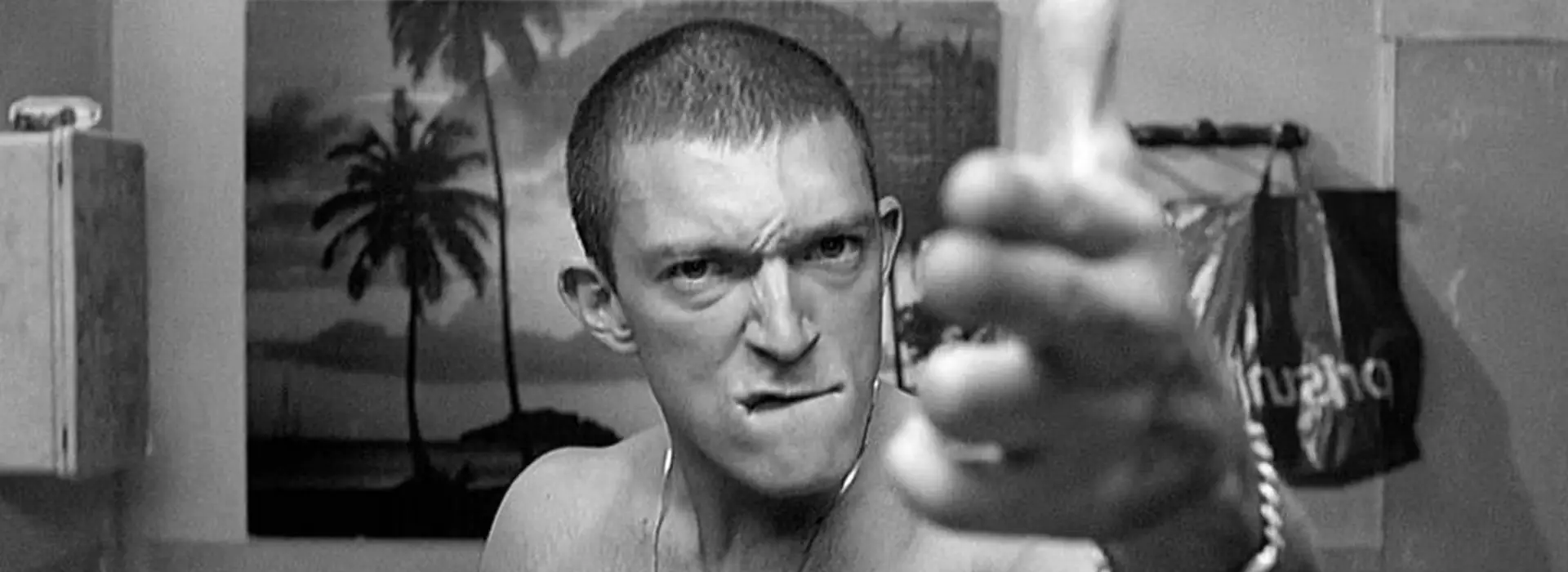
6. La Haine: Continuous movement and on-the-ground urgency
Mathieu Kassovitz captures social tension through radical technical choices. The cinematography in*La Haine*is designed to convey raw energy and a latent threat.
The fluidity of the Steadicam
The film makes extensive use of the Steadicam to follow the three main characters as they move. The camera remains in almost perpetual motion, which prevents any narrative pause. This choice gives the long takes a fluidity that contrasts with the social immobility of the protagonists. The camera hovers around them, creating a sense of constant surveillance.
The use of focal lengths and black and white
The use of short focal lengths slightly distorts the backgrounds and lends an unusual sense of scale to the suburban settings. Black and white, far from softening reality, makes it all the more stark. It standardises the textures of the concrete, removes colour cues and focuses attention on the contrasts of light and the harshness of the faces. The famous ‘reverse tracking shot’ (trans-trav), used in the Paris scene, technically illustrates the characters’ spatial and mental disorientation when faced with the capital.
7. Pulp Fiction: Chronological deconstruction and the framework of dialogue
WithPulp Fiction,Quentin Tarantino demonstratesa particular mastery of narrative structure and the rhythm of spoken exchanges.
The circular editing
The film abandons linear chronology in favour of a looping structure, composed of intersecting segments. This deconstruction forces the viewer to constantly re-evaluate what they are seeing. An opening scene is resolved at the end of the film, altering the meaning of previous events. Tarantino demonstrates that maintaining the viewer’s attention does not depend on a logical sequence of events, but on the intensity of the situations.
The staging of dialogue
For Tarantino, dialogue is an action in itself. He often chooses to film these lengthy exchanges in wide shots or fluid sequence shots, limiting cuts so as not to disrupt the musicality of the lines. The camera remains stationary or moves in slow tracking shots that follow the action. The tension arises from the dialogue and the acting, without the need for frenetic editing to energise the screen.
8. Inception: Exposition through action and the expansion of time
WithInception, Christopher Nolan deliversa technical masterclass in handling complex storylines and the interweaving of timelines.
Multi-level cross-cutting
The film’s third act unfolds across four simultaneous levels of reality. Nolan uses cross-cutting to link these layers. The technical challenge lies in maintaining clarity: the viewer must understand which level they are on with every change of shot. The director achieves this by assigning each level a distinct colour scheme, a specific atmosphere (the rain, the hotel with its warm tones, the snow) and a different pace.
The dilation of time
The film applies a precise physical rule: time passes more slowly at each lower level of the dream. The editing incorporates this mathematical principle. An action that takes a second on the first level – such as a van falling – is stretched out over several tens of minutes of screen time through the use of technical slow motion and its integration into the overall rhythm of the editing sequence.
9. Spirited Away: The Depth of the Animation and the Use of Negative Space
Animated films are subject to the same production requirements as live-action films. InSpirited Away, Hayao Miyazaki demonstratesa keen understanding of space and visual rhythm.
Drawn Depth of Field
Although traditional animation is flat by nature, Miyazaki recreates depth of field. He plays on the differences in sharpness between the foregrounds, the main subject and the distant backgrounds. The use of wide shots with elements cluttering the foreground emphasises the vastness of the public baths. The use of scale – contrasting Chihiro’s small stature with the outsized proportions of the creatures and architecture – is central to the film’s staging.
The concept of ‘Ma’
Miyazaki incorporates the Japanese notion of ‘Ma’, which refers to a moment to breathe, an empty space. The film features sequences where the action comes to a complete standstill, such as the train journey scene. These moments of silent contemplation do not directly advance the plot, but they regulate the overall rhythm of the work. They allow the audience to process the frenetic sequences that have gone before and set the stage for the tension of the scenes to come.
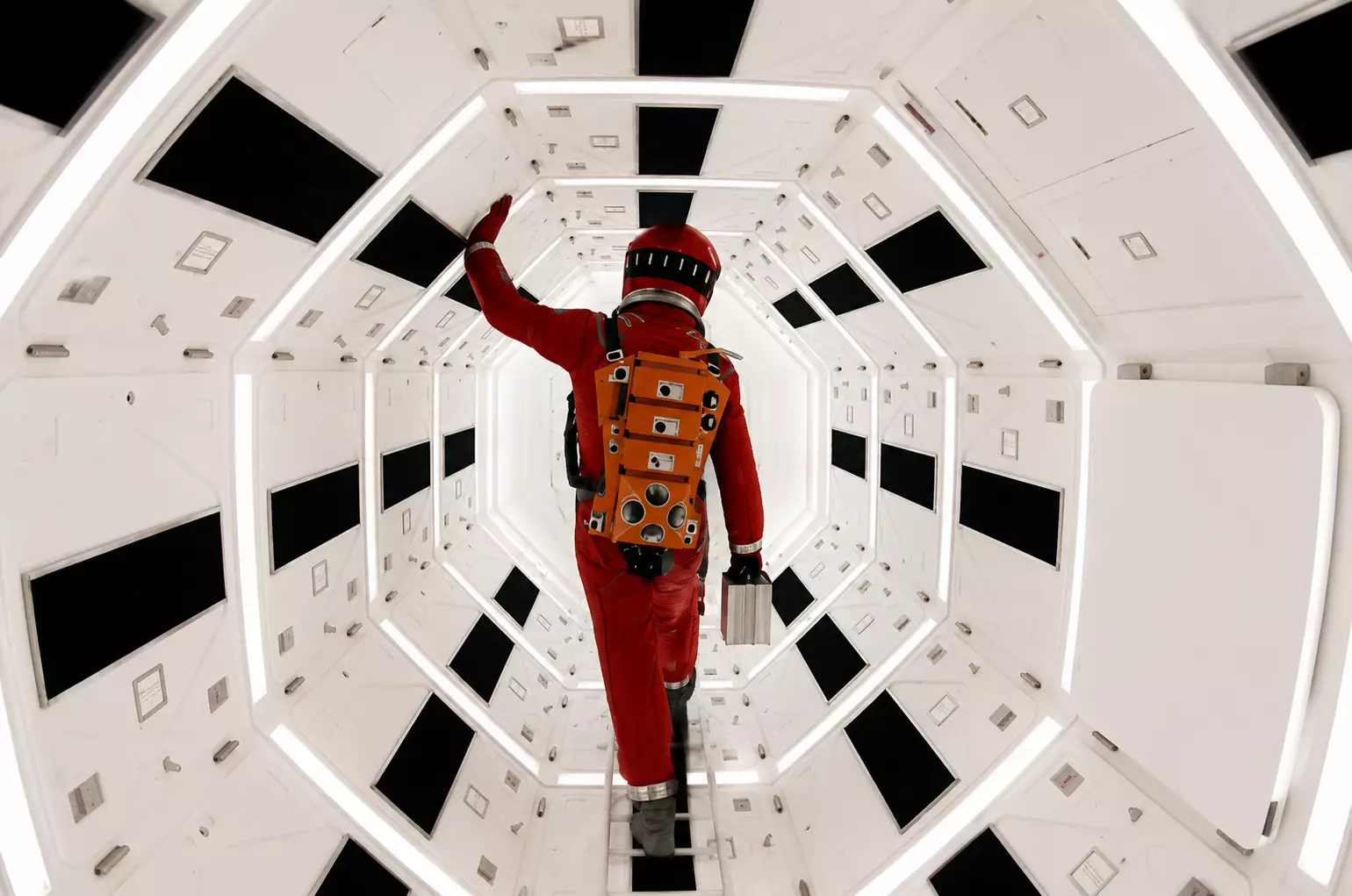
10. 2001: A Space Odyssey – Visual abstraction and seamless continuity
Stanley Kubrick’s work takes narrative minimalism to the extreme. The film is studied for its ability to communicate complex concepts almost exclusively through imagery.
Symmetry and perspective
Kubrick’s direction is based on rigid geometry. The interior shots of the Discovery One spacecraft are constructed around very distinct central vanishing points. This perfect, cold and mathematical symmetry reflects the dominance of the machine over man. The camera moves very little, or performs slow, almost mechanical tracking shots, mirroring the trajectory of objects in space.
The transition in movement
The film contains one of the most famous temporal ellipses in the history of cinema: a bone thrown into the air by a primate is transformed, via a cut, into a spacecraft in orbit. This edit, based on a similarity of form and movement, condenses millions of years of technological evolution into a fraction of a second. It demonstrates the unique ability of cinematic editing to compress time and link conceptual ideas without a single word of explanation.
Viewing these works forms the basis of a visual grammar. The aim is not to reproduce these shots identically, but to understand the operational logic underlying them. Analysing the lighting in a scene, the rhythm of a cut or the angle of a camera helps students develop the reflexes needed to design and structure their own images in a considered manner.